Treatment guide
Breast cancer treatments, side effects and preparation.
Chemotherapy
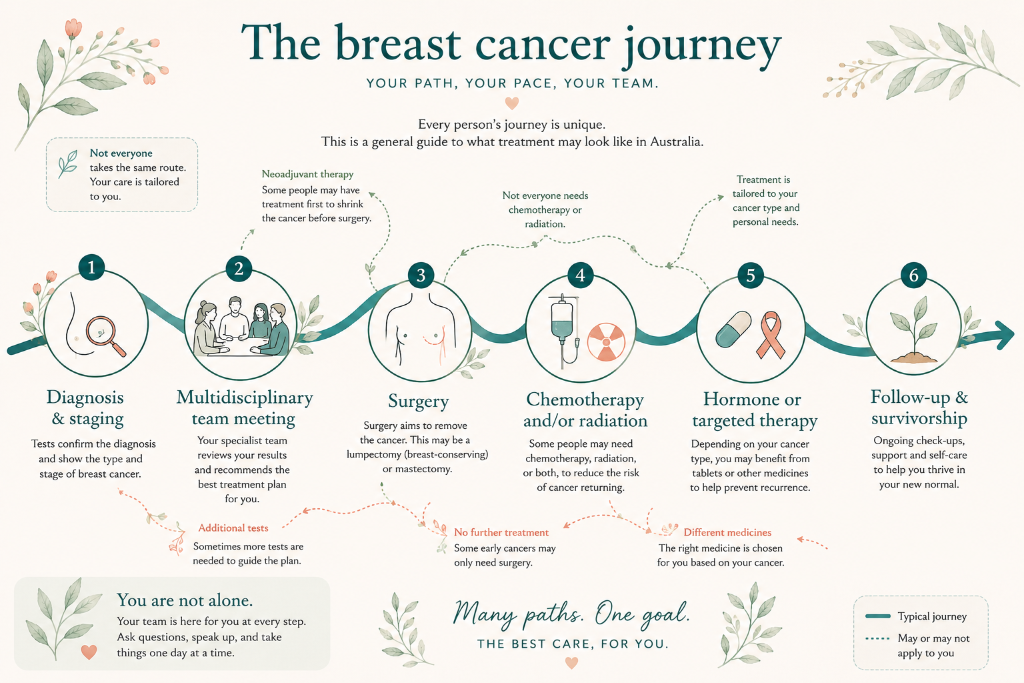
Chemotherapy uses cytotoxic drugs to kill cancer cells throughout the body. It can be given before surgery (neoadjuvant) to shrink the tumour and assess response, or after surgery (adjuvant) to reduce recurrence risk. Common Australian regimens (eviQ) include AC-T (doxorubicin and cyclophosphamide followed by a taxane), TC (docetaxel and cyclophosphamide), and dose-dense AC-paclitaxel. For HER2-positive disease, chemotherapy is combined with HER2-targeted therapy (trastuzumab, with or without pertuzumab; T-DM1 if there is residual disease after neoadjuvant therapy, per the KATHERINE trial). For high-risk stage II-III triple-negative breast cancer, pembrolizumab is added to neoadjuvant chemotherapy and continued adjuvantly (KEYNOTE-522). Not everyone needs chemotherapy; genomic assays (Oncotype DX, MammaPrint, and Prosigna) help guide decisions in HR-positive HER2-negative early breast cancer.
Video tutorial
Educational videos from trusted medical sources, including BCNA, Cancer Council, and hospitals.
Key facts
- Not everyone needs chemotherapy; genomic assays (Oncotype DX, MammaPrint, and Prosigna) help avoid it in selected HR-positive HER2-negative early breast cancers
- Side effects vary widely; most are temporary and well managed with supportive medications and dose adjustments
- Hair generally regrows within 3-6 months of finishing; scalp cooling is increasingly offered in Australian day units
- Fertility preservation should be discussed before starting; egg or embryo freezing is well established in Australia and Medicare-rebated for cancer patients
- Effective non-hormonal contraception is recommended throughout chemotherapy and for 6-12 months afterwards
- For BRCA1/2 carriers with high-risk early disease, adjuvant olaparib for 1 year improves disease-free and overall survival (OlympiA)
- Cancer Australia and eviQ provide the protocol framework Australian oncologists use
Treatment duration
3-6 months for most early breast cancer regimens. HER2-targeted therapy (trastuzumab, with or without pertuzumab) usually continues for 12 months in total; T-DM1 for 14 cycles if used; adjuvant pembrolizumab for approximately 9 months in TNBC; and adjuvant olaparib for 12 months in eligible BRCA carriers.
What to expect
- 1Treatment is usually given in cycles over 3-6 months (typically every 2 or 3 weeks)
- 2Each cycle includes treatment days followed by recovery days
- 3Administered through an intravenous line; most people have a port-a-cath or PICC line for repeated access
- 4Pre-medications (steroids, anti-nausea, antihistamines) given before infusion
- 5Full blood count and observation before every cycle
- 6Sessions usually take 2-4 hours; the first AC or first taxane is often longer for safety monitoring
Potential side effects
Not everyone experiences all side effects. Talk to your team about management strategies.
Important: This information is for educational purposes only and should not replace advice from your medical team. Every person's treatment plan is unique and tailored to their specific diagnosis.