Need to tell adults too? See Talking about cancer
Difficult conversations guide for partners, family, friends, work — for patients and carers.
Why telling children matters
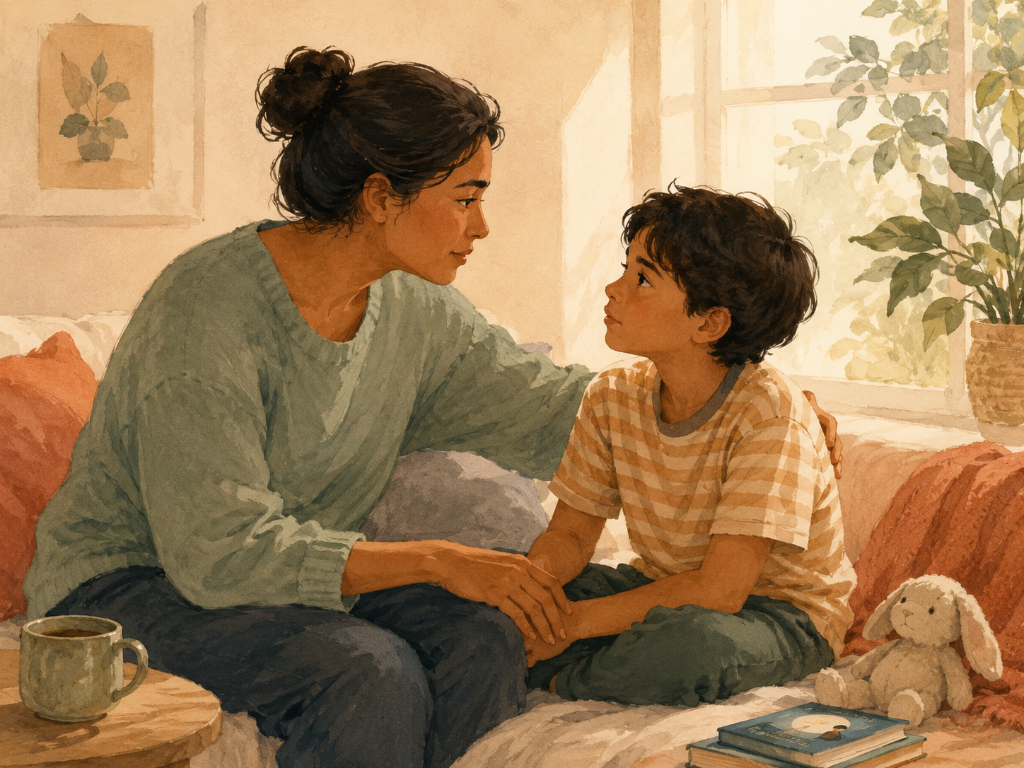
Children know when something is wrong. Even young children pick up on stress, changes in routine, and hushed conversations.
Not telling them can lead to:
- Anxiety and fear of the unknown
- Imagination creating scenarios worse than reality
- Feeling excluded or unimportant
- Loss of trust if they find out another way
- Self-blame (children often think they caused problems)
Being honest in an age-appropriate way helps children feel secure, included, and able to support you in their own way.
What to say: Age-banded scripts (with read-aloud)
🧸 Ages 4-6 (preschool / early primary)
Keep it very simple, very short, very concrete. Use familiar words.
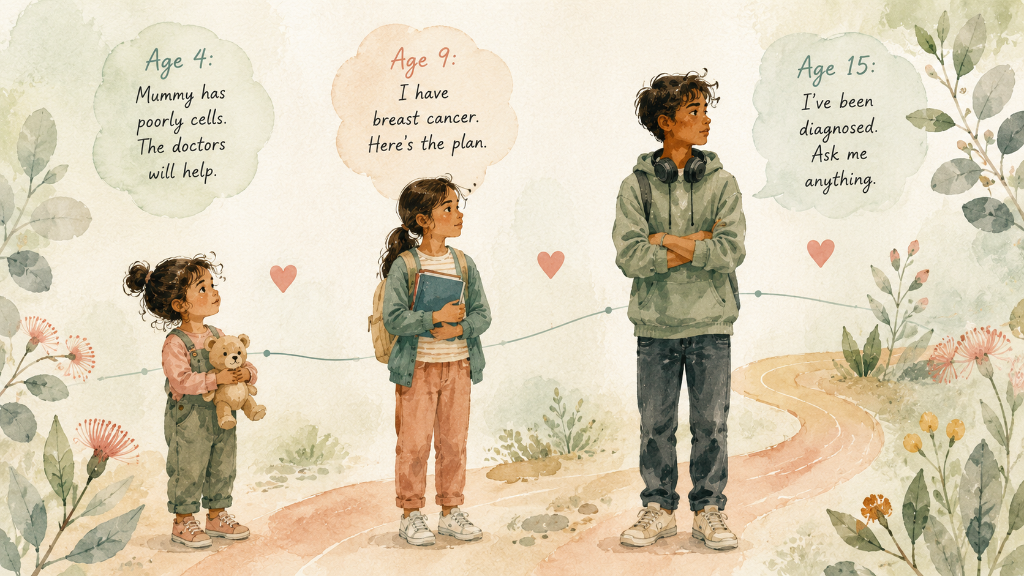
Sweetheart, I need to tell you something important. pause Mummy has some poorly cells in her breast. pause The doctors are going to give me special medicine to help me get better. pause I might feel tired sometimes, and my hair might fall out. pause But I will still be here. I will still love you. And none of this is because of anything you did. pause Do you have any questions? It's okay if you don't.
- Use simple words like "poorly cells" instead of "cancer"
- Reassure repeatedly: "You didn't cause this"
- Keep routines steady — consistency helps them feel safe
- Expect questions to come back days or weeks later
🎒 Ages 7-10 (primary school)
They can handle real words and a basic explanation. They need a plan.
I want to talk to you about something. pause I have breast cancer. That means some cells in my breast started growing when they shouldn't. pause The doctors have found it, and they have a plan to treat it. pause I'll have an operation, and I might need some other treatments. I might lose my hair for a while — it grows back. pause Some days I'll feel really tired. Other days I'll feel okay. pause You didn't cause this. Nobody caused this. And it's not something you can catch from me. pause What questions do you have?
- Use the real word 'cancer' — they\'ll hear it from someone else otherwise
- Be honest about hair loss before it happens
- Reassure: cancer is not contagious
- Let them help in small ways — making tea, drawing pictures
📚 Ages 11-14 (early teens)
They want facts and they want honesty. Treat them as the near-adults they are.
I need to talk to you about something serious. pause I've been diagnosed with breast cancer. pause I know that's a scary word. The doctors caught it early/at this stage [as appropriate], and they have a treatment plan. That plan involves [surgery / chemo / radiation / hormone tablets]. pause Things at home will look different for a while. I'll be tired. I might be in hospital for a few days. Other people will help us. pause I'll always tell you the truth. If something changes, I'll let you know. pause You can ask me anything — now or any time. You can also talk to [trusted adult] if you don't want to talk to me. pause It's also completely okay to feel angry, scared, sad — or to feel nothing right now. All of that is normal.
- Tell them the truth at their level — avoid medical-jargon overload
- Name a second trusted adult they can talk to if it's not you
- Watch for changes at school — talk to teachers/school counsellor
- Expect mood swings — both about cancer and about being a teen
🎧 Ages 15+ (older teens / young adults)
Treat them as adults. Share the full picture, including uncertainty.
I want to have a proper conversation with you. pause I've been diagnosed with breast cancer. Stage [X], [subtype], [treatment plan]. pause Here's what I know so far: [details]. Here's what I don't know yet: [details]. pause I'm not going to hide anything from you. I'd rather you knew, even when the news is hard. pause I might need your help with [practical things]. I also want you to keep living your life — your friends, your study, your work. This is not your responsibility to carry alone. pause If you want to talk to someone outside the family, Canteen runs free programs for people your age. pause I love you. We'll get through this. Ask me anything.
- Share clinical detail if they want it — stage, treatment, prognosis
- Acknowledge they might withdraw, get angry, or seem unaffected
- Connect them with Canteen (12-25 years) — peer support matters
- Watch for school/uni performance dips, alcohol/drug coping signals
- Be clear: caring for you is not their job
Helpful phrases to use
Support services for children
Canteen - 1800 226 833
Free support, counselling, and online community for 12-25 year olds when a parent or sibling has cancer (or after their death). canteen.org.au
Camp Quality - 1300 662 267
Programs, in-hospital support, and family camps for children 0-15 years affected by cancer in the family. campquality.org.au
Redkite - 1800 733 548
Financial assistance, counselling, and practical support - primarily for families of children/young people with cancer. redkite.org.au
Cancer Council - 13 11 20
Free information and counselling, including the booklet Talking to Kids About Cancer for parents and carers. cancer.org.au
BCNA - 1800 500 258
Family-focused resources within the My Journey breast cancer toolkit. bcna.org.au
Practical tips
Use age-appropriate books to help start the conversation.
Maintain routines - keep bedtimes, school, and activities as normal as possible.
Let them help - small tasks help them feel involved.