What you need to know
TUG (Transverse Upper Gracilis) and PAP (Profunda Artery Perforator) flaps use tissue from the inner thigh to reconstruct the breast. Both are free flaps - the tissue is fully detached and the blood vessels reconnected to vessels in the chest under a microscope.
When thigh flaps are used: not enough abdominal tissue for DIEP (slim build, previous tummy tuck, prior abdominal surgery), reconstructing smaller-volume breasts, or when preserving the abdomen is preferred.
Thigh flaps are performed by a smaller number of microsurgical units in Australia. Surgeon and team volume matters - outcomes are best in centres that perform these regularly.
TUG vs PAP: what's the difference?
TUG flap (Transverse Upper Gracilis)
Takes a horizontal ellipse of skin and fat from the inner thigh together with the gracilis muscle (which provides reliable blood supply to the skin paddle). One of the longer-established alternatives to DIEP.
Functional impact: The gracilis is a small adductor (helps bring the legs together). Most people don't notice meaningful long-term functional loss for everyday activities, although some report mild thigh weakness.
PAP flap (Profunda Artery Perforator)
Takes skin and fat only from the upper inner thigh / lower buttock crease, supplied by perforators of the profunda femoris artery. No muscle is taken.
Advantage: Muscle-sparing. The scar is usually hidden in the buttock crease/upper inner thigh. Technically demanding (smaller, more variable vessels), so requires high microsurgical experience.
TUG flap: visual walkthrough
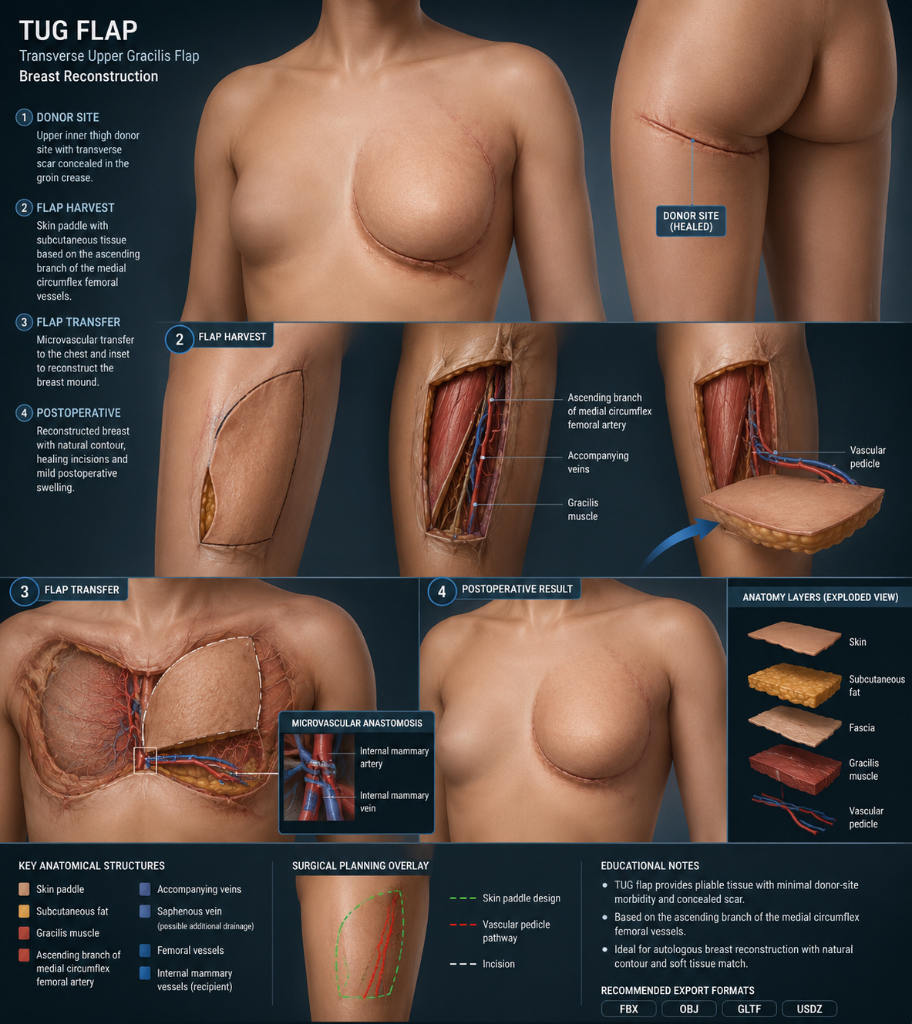
Stages shown: (1) inner thigh donor site, (2) flap harvest with the gracilis muscle and ascending branch of the medial circumflex femoral vessels, (3) microvascular transfer to the internal mammary vessels, (4) reconstructed breast with healed thigh donor site.
Educational illustration only. Scars, contour, and healing vary between patients.
What to expect
Surgery: 6-8 hours for unilateral, 9-12 hours for bilateral. Pre-operative imaging (CTA or MRA) is usually used to map perforators.
Hospital stay: 3-5 nights with ERAS. Frequent flap checks, especially in the first 24-48 hours. Calf compression devices and prophylactic anticoagulation are routine.
Thigh scar: TUG - horizontal scar high on the inner thigh, hidden by underwear and most swimwear. PAP - scar in the buttock crease/inner thigh, usually well hidden.
Thigh recovery: Walking is uncomfortable for the first week; the donor area feels tight and sometimes numb. Most adapt within 2-3 weeks. Wound problems (delayed healing, seroma, lymph leak) are more common than abdominal donor sites.
Breast appearance: Soft and warm. Volume well-suited to small/medium breasts. Some surgeons "stack" two thigh flaps for a single larger breast in slim women. Final shape settles over 6-12 months; revision lipofilling is common.
What to ask your team
Clinical facts
Prevalence: Together TUG and PAP flaps account for roughly 5-10% of autologous breast reconstructions in Australia - a smaller proportion than DIEP and LD.
Flap success: Modern series report total flap success around 96-98% for both TUG and PAP in experienced centres. Failure rates are slightly higher than DIEP because the perforators are smaller and more variable.
Donor-site complications: Wound dehiscence, seroma, and lymph leak occur in roughly 15-25% of cases. Most are managed conservatively. PAP is often associated with a lower seroma rate than TUG.
Patient satisfaction: High in slim, small-breasted women (BREAST-Q satisfaction with breast comparable to DIEP); volume match is excellent for A-C cups.
Tips
Choose a high-volume microsurgical unit. Thigh flaps are technically demanding - outcomes are strongly linked to surgeon and team experience.
Wear loose, soft trousers or skirts for 4-6 weeks. Tight clothing on the inner thigh is uncomfortable and can rub on healing wounds.
Avoid wide-leg positions (squats, deep yoga splits) for 4-6 weeks. They stretch the donor closure and increase seroma risk.