Why men get breast cancer
Men have breast tissue, though much less than women. This tissue can develop cancer just like female breast tissue.
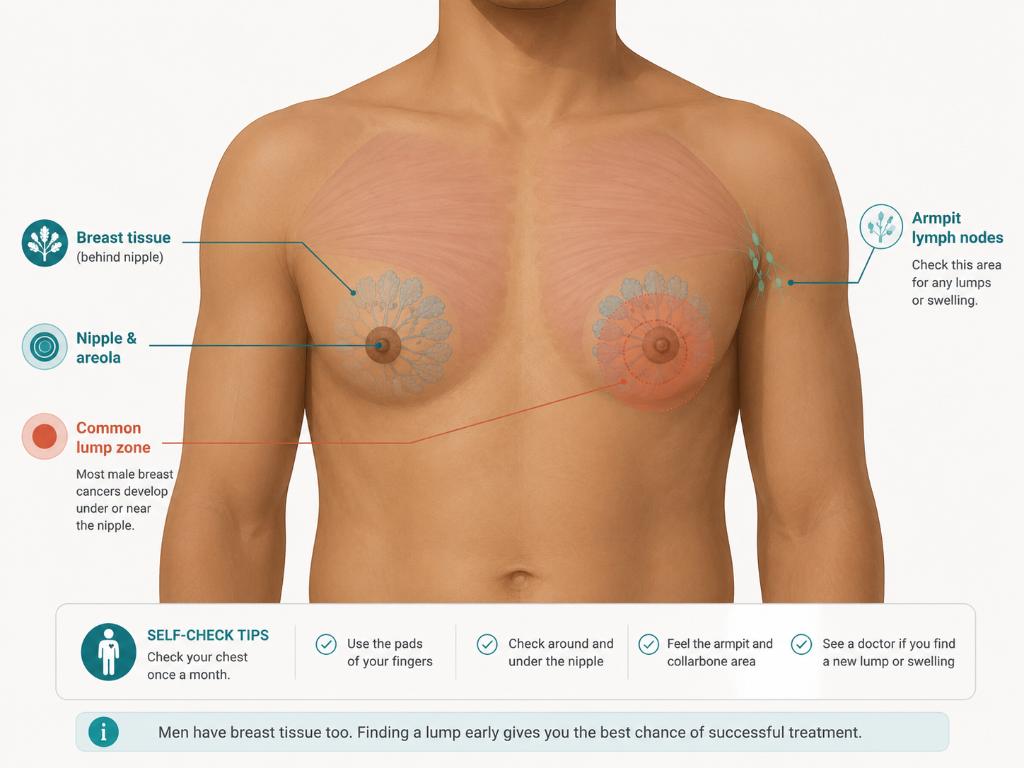
Risk factors for men include:
Age
Most common in men aged 60-70
Family history
BRCA2 mutations significantly increase risk
Klinefelter syndrome
Genetic condition with extra X chromosome
Liver disease
Cirrhosis can increase oestrogen levels
Obesity
Higher body fat increases oestrogen production
Radiation exposure
Previous chest radiation therapy
Most men with breast cancer have no identifiable risk factors
Having a risk factor does not mean you will get breast cancer, and not having risk factors does not mean you are immune.
Common symptoms
The most common sign is a painless lump or thickening behind or near the nipple. Unlike women, men rarely have routine breast screening, so cancers are often detected later.
Symptoms to watch for:
- Lump or swelling in breast tissue (usually painless)
- Nipple changes (inversion, retraction, dimpling, or discharge)
- Skin changes (redness, scaling, puckering, or thickening)
- Lump in the armpit
- Changes in breast shape or size
What to ask your team
Clinical facts
Incidence (Australia): Around 200 men are diagnosed with breast cancer each year, less than 1% of all breast cancers. Lifetime risk to age 85 is approximately 1 in 668 (0.15%) for Australian men, compared with about 1 in 7 for women (Cancer Australia).
Age at diagnosis: Median 67-70 years, about 5-10 years later than for women.
Hormone receptor status: Around 90% of male breast cancers are ER-positive.
BRCA2 and BRCA1: BRCA2 mutations account for an estimated 10-15% of male breast cancers, with a lifetime breast cancer risk of around 6-8% for BRCA2 carriers; BRCA1 mutations confer a smaller but still elevated risk (approximately 1-2% lifetime). Men with breast cancer in Australia are routinely offered referral to a familial cancer service for genetic counselling.
Five-year survival: 87% in Australia (compared with 93% for women), driven largely by later stage at presentation. Stage-for-stage outcomes are similar between sexes.
Tips and support
Find male-specific support. BCNA has resources for men. Ask your breast care nurse about connecting with other men who have been through this.
Advocate for yourself. If you feel dismissed or uncomfortable in "pink ribbon" spaces, speak up. Your experience matters.
Consider genetic testing. Especially if you are under 50 or have family history. Results affect your relatives' risk too.