Interactive · Scar location preview
Tap a surgery type to see where the scar(s) typically sit. Diagrams are schematic — actual scars vary by surgeon, technique and your anatomy.
Breast-conserving
Mastectomy
Reconstruction
Chest (front view)
- Horizontal ellipse
Simple mastectomy
Horizontal elliptical scar across the chest, removing breast tissue, the nipple and a slim ellipse of skin. Typically 15–20 cm.
What you need to know
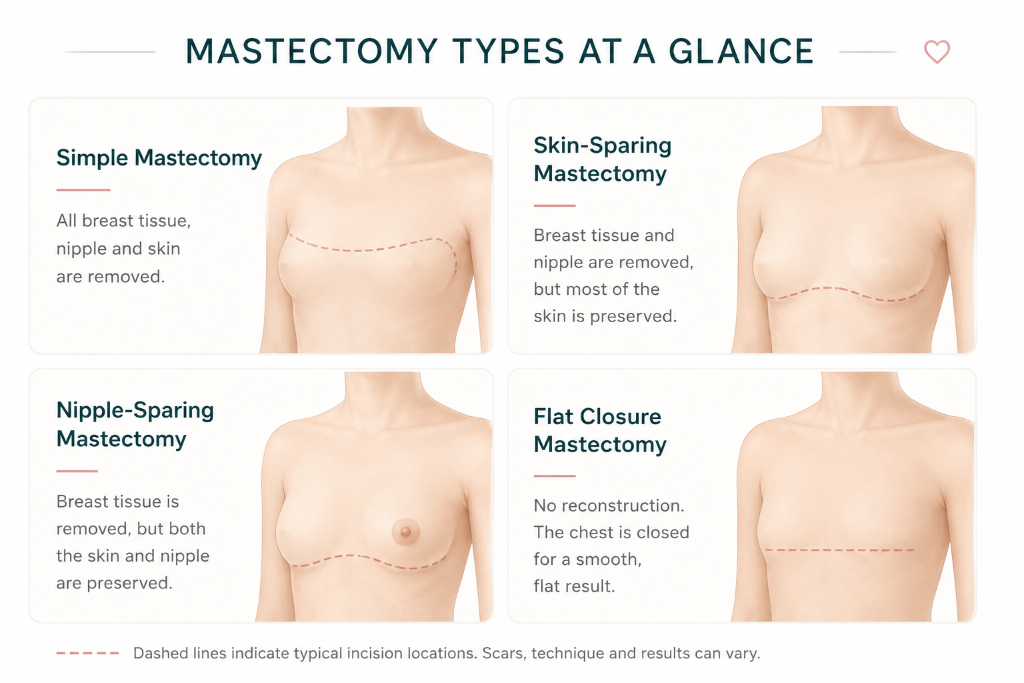
A mastectomy removes all the breast tissue. The four main types differ in how much skin and nipple are kept:
Simple (total) mastectomy
Removes all breast tissue, the nipple, and a horizontal ellipse of skin. Used when the skin needs to be removed (for skin involvement or a large tumour), or when reconstruction is not planned. Now usually performed without removing the pectoralis muscle (the older "radical" mastectomy is no longer routinely used).
Skin-sparing mastectomy
Removes the breast tissue and nipple but keeps most of the skin envelope. Designed for immediate reconstruction.
Nipple-sparing mastectomy (NSM)
Keeps the entire skin envelope and the nipple-areola complex. Best cosmetic result. Now considered oncologically safe in carefully selected patients: usually tumours that are small, more than approximately 1-2 cm from the nipple, and not involving the skin. Increasingly used for risk-reducing (prophylactic) mastectomy in BRCA carriers.
Flat closure / aesthetic flat closure
Mastectomy without reconstruction, with deliberate effort to leave a smooth, flat chest wall. Learn more →
What to expect

Hospital stay: 1-3 nights for mastectomy alone. Some Australian centres now offer same-day or 23-hour discharge for simple mastectomy plus flat closure (with home drain support). Longer stays apply with immediate reconstruction (typically 2-5 nights, depending on type).
Drains: one or two soft tubes drain fluid from under the skin. They are removed when output drops below approximately 30 mL per day, usually 7-14 days. You will be taught how to empty and record output before going home.
Pain and sensation: tightness and pulling are normal. Sharp, shooting "nerve" pain (intercostobrachial nerve irritation) is common in the first weeks and usually settles. Numbness across the chest wall, armpit, and inner upper arm is permanent for most people, although patches of sensation may slowly return over months. Multimodal pain relief (paracetamol, an anti-inflammatory, and a short-term opioid) is now standard, with reduced opioid prescribing under enhanced recovery (ERAS) protocols.
Arm exercises: gentle range-of-motion exercises start the day after surgery, supervised by a physiotherapist or breast care nurse. Restrictions on heavy lifting (typically more than 2-5 kg) apply for 4-6 weeks.
Sentinel lymph node biopsy: usually performed at the same time when the cancer is invasive. For some early DCIS treated with mastectomy, sentinel node biopsy is also done because residual invasive cancer is occasionally found. For selected older patients with small, low-risk cancers and a normal axillary ultrasound, omitting SLNB is being studied (SOUND and INSEMA trials). Discuss this with your team.
What to ask your team
Clinical facts
Australian context: about 21,000 people are diagnosed with breast cancer in Australia each year (approximately 58 per day). Mastectomy is performed in approximately 35-40% of cases; the rest are managed with breast-conserving surgery. Bilateral mastectomy rates have risen modestly in recent years.
Reconstruction rates: around 25-30% of Australian women who have a mastectomy proceed to breast reconstruction, which is lower than in many comparable countries. Access varies between public and private systems, and between metropolitan and regional centres.
Nipple-sparing safety: in appropriately selected patients (tumour at least 1-2 cm from the nipple, not multicentric, and with no skin involvement), local recurrence rates are comparable to skin-sparing mastectomy, and overall survival is preserved across multiple long-term studies, including 10 or more years of follow-up in BRCA carriers.
Lymphoedema: risk is roughly 5-10% after sentinel node biopsy alone, and 15-25% after axillary clearance, with higher risk if radiation is added. Early physiotherapy and gentle progressive activity reduce risk.
Help with prosthesis, post-surgery bras and recovery costs
Many states subsidise external prostheses and post-mastectomy bras. Charity grants can also help with bills and at-home support during recovery.
Tips
Pack button-up tops, zip-front jackets, and a soft front-fastening bra. You will not be able to lift your arms over your head comfortably for several weeks.
Practise drain care before discharge. Your nurse will show you how to empty, measure, and "milk" the drains. Bring a small notebook to record output (or use the Notes app).
Sleep slightly propped up on pillows for the first 1-2 weeks. It is more comfortable, helps drainage, and reduces swelling.