Why small breasts can be challenging
Small breasts present unique positioning challenges during mammography because there is less tissue volume to work with. The compression paddle must adequately image all breast tissue while the technologist tries to position tissue that may not extend far from the chest wall.
This doesn't mean mammograms don't work
It simply means the technologist needs good technique and experience, and you may need to advocate for yourself to ensure optimal imaging.
Main challenges include:
Difficult positioning
Less tissue to 'pull forward' onto the compression paddle
Chest wall inclusion
Harder to image tissue close to the chest without including ribs/muscles
Nipple positioning
More difficult to ensure the nipple is in profile in both views
Adequate compression
Finding balance between image quality and excessive pain
Positioning techniques for small breasts
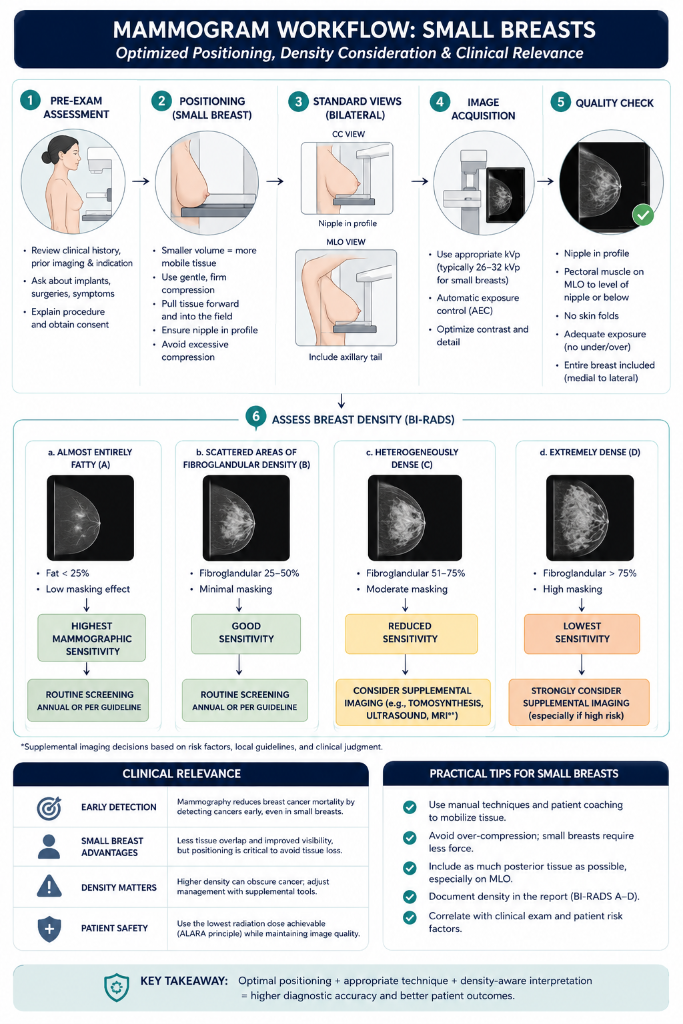
An experienced technologist will use specialized positioning techniques for small breasts:
1. Tissue mobilization
Gently pulling breast tissue forward from the chest wall and sides
2. Body positioning adjustments
Asking you to lean in closer, turn your body, or lift your arm differently
3. Smaller compression paddle
Some facilities have smaller paddles specifically for small breasts
4. Patient relaxation
Talking you through the process (tension makes positioning harder)
5. Extra time
Taking additional time to position correctly rather than rushing
Questions to ask your team
Clinical facts
Breast size and risk: Breast size itself is not a meaningful risk factor for breast cancer or for prognosis once cancer is diagnosed.
Positioning: The most common technical failure in small-breast mammography is incomplete inclusion of posterior (chest-wall) tissue. Experienced technologists, smaller compression paddles, and patient-friendly positioning largely overcome this.
Detection: When technique is adequate, mammographic sensitivity is comparable in small and larger breasts.
Density: Small breasts are more often dense. Mammographic sensitivity falls from around 85-90% in fatty breasts to around 60-65% in extremely dense breasts - supplementary ultrasound (or MRI in high-risk women) can help close this gap.
Tips for a better experience
Choose BreastScreen Australia or a dedicated breast imaging center. They have the most experienced technologists.
Take pain relief 30-60 minutes beforehand if you've had painful mammograms previously.
Trust your instincts. If something doesn't feel right, speak up or seek care elsewhere.