What you need to know
Breast density describes the tissue composition
Breast density describes the amount of fibrous and glandular tissue (dense tissue) compared to fatty tissue in your breast. It can only be determined from a mammogram - you cannot tell by looking at or feeling your breasts.
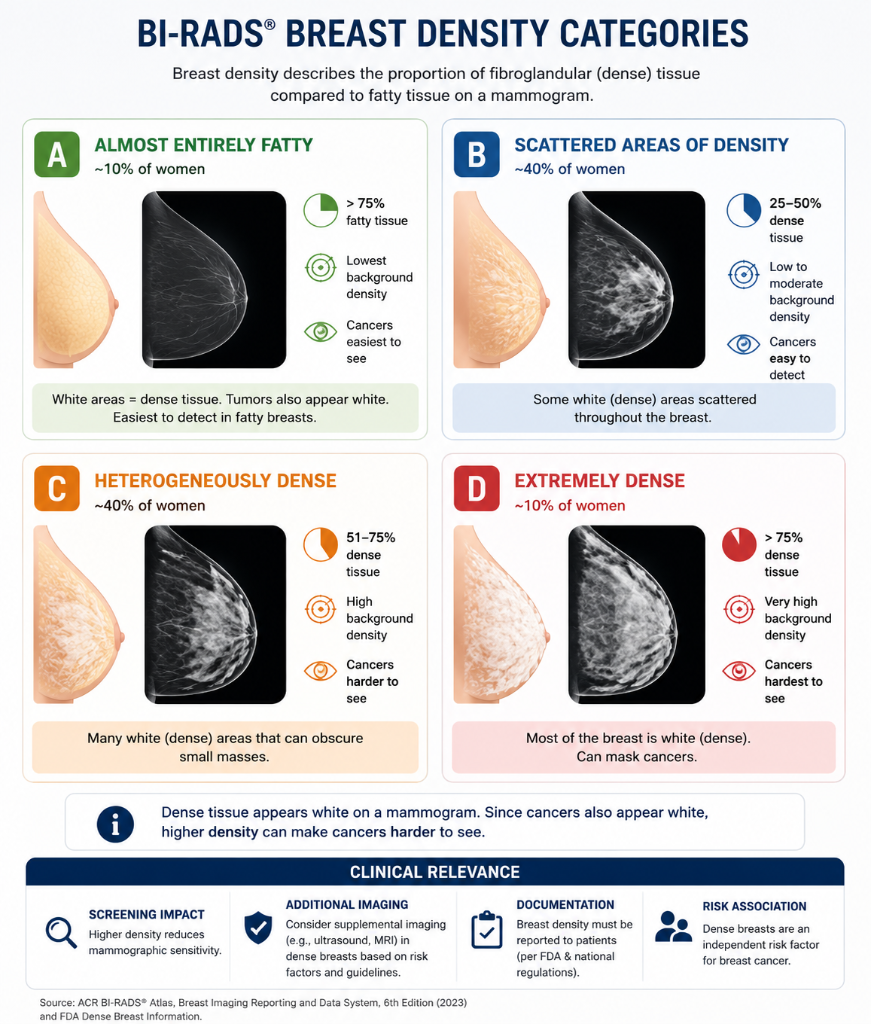
Dense breasts matter for two reasons:
1. Dense tissue appears white on a mammogram, and so does cancer. Dense tissue can "mask" a tumour, making it harder to detect.
2. Having dense breasts (category C or D) is an independent risk factor for breast cancer, increasing risk by approximately 1.5-2 times compared to average density.
What to expect
Following a 2025 BreastScreen Australia policy update, all states and territories are now progressively notifying women of their mammographic breast density in their written results. NSW began reporting in April 2025; Victoria began rollout in 2024-2025. Other states are following on different timelines - confirm current practice with your local BreastScreen service.
If you are told you have dense breasts (category C or D), you may be advised to discuss supplementary screening with your GP. There is no current Medicare rebate specifically for "screening" ultrasound or MRI based on density alone - out-of-pocket costs may apply unless you meet other criteria (e.g. high familial risk).
Your density can change over time. It tends to decrease with age and after menopause.
What to ask your team
Clinical facts
Mammographic sensitivity: Falls with increasing density - from around 85-90% in mostly fatty breasts (category A) to around 60-65% in extremely dense breasts (category D).
Supplementary ultrasound: In dense breasts, automated or hand-held supplementary ultrasound detects an additional 2-4 cancers per 1,000 women screened. It also increases false-positive recalls and benign biopsies; this trade-off is part of the conversation.
Supplementary MRI (DENSE trial, 2019; long-term follow-up 2024): In women with extremely dense breasts and a normal mammogram, biennial MRI roughly halved interval cancers compared with mammography alone. MRI is not yet routinely funded for density alone in Australia and is generally restricted to high familial/genetic risk under MBS.
National policy (2025): BreastScreen Australia's updated position statement recommends notifying participants of their mammographic density. Implementation is rolling out at different rates across states and territories.
Tips
Ask for your density category. You have the right to know.
Dense breasts are normal. About half of all women have heterogeneously or extremely dense breasts.
Do not panic about density. Having dense breasts is a risk factor, not a diagnosis. It means you may benefit from additional screening, not that you have cancer.