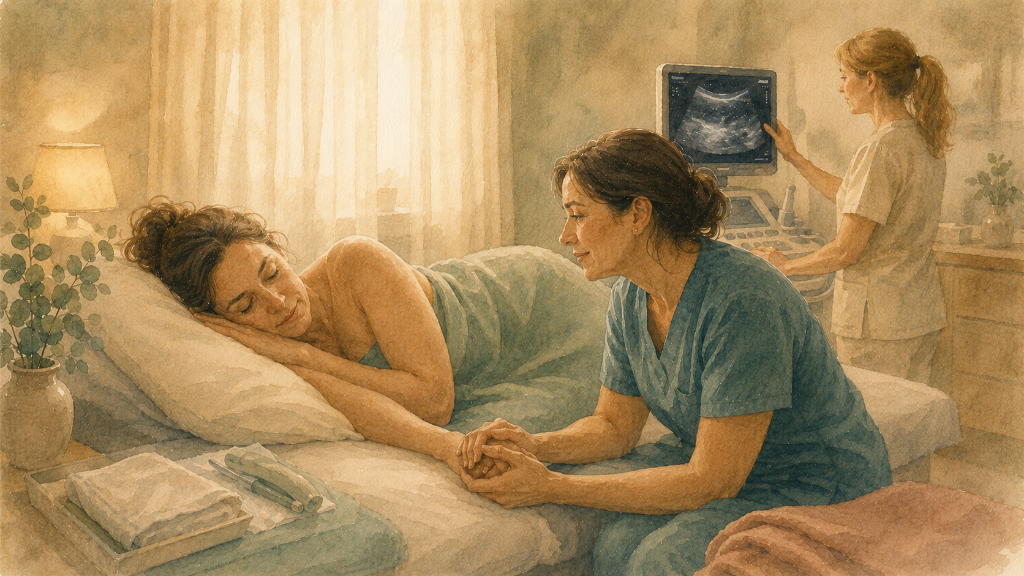
Three main types of biopsy
Core needle biopsy (most common)
Uses a hollow needle to remove several tissue samples. Performed under local anaesthetic, guided by ultrasound or mammogram. Takes 15-30 minutes.
Pain level: Similar to a dental injection. Brief sharp sensation when local goes in, then pressure during sampling.
Vacuum-assisted biopsy (VAB)
Uses a larger hollow needle with vacuum suction to remove multiple samples through one insertion. Also called mammotome or BLES. Takes 30-45 minutes.
Pain level: Similar to core biopsy but takes longer. More bruising afterward.
Surgical (excisional) biopsy
Removes the entire lump in an operating theatre under general anaesthetic. Used when needle biopsy is not possible or does not provide a clear answer. Leaves a scar.
Recovery: 1-2 weeks. Treated like minor surgery.
Step by step: Core needle biopsy
Local anaesthetic injection
Numbs the skin and breast tissue. Feels like a bee sting for a few seconds.
Small skin nick
A tiny cut (2-3 mm) to allow the needle through. No stitches needed.
Needle insertion
The needle is guided into the lump using ultrasound or mammogram. You hear a loud click as samples are taken (the spring-loaded mechanism). Usually 3 to 6 samples.
Pressure and dressing
Firm pressure for 5 to 10 minutes to stop bleeding. Dressing applied. You can go home immediately.
What to expect after biopsy
Before the biopsy: You can eat and drink normally. Wear comfortable two-piece clothing. Bring someone to drive you home if possible (not essential but recommended).
During the biopsy: You'll lie on a bed or sit in a chair. The radiologist uses ultrasound or mammogram to locate the area. You'll feel pressure and hear clicking sounds, but it should not be severely painful.
After the biopsy: Expect bruising (sometimes significant), swelling, and tenderness for 5-7 days. A firm supportive bra helps. Paracetamol is usually enough for pain. Avoid taking aspirin or ibuprofen for pain relief in the first 24 hours, as they increase bleeding.
If you take prescribed blood thinners: do not stop aspirin, clopidogrel, warfarin, apixaban, rivaroxaban, or any other prescribed anticoagulant on your own. Tell the clinic before your biopsy and follow their specific instructions; they will advise whether anything needs to be paused.
Results: Usually available within 3-7 working days. Your GP or breast surgeon will call you with results and next steps.
What to ask your team
Clinical facts
Diagnostic accuracy: Image-guided core needle biopsy has 97-99% accuracy in experienced breast assessment services.
Complication rate: Significant bleeding or infection occurs in less than 1% of biopsies. Bruising and tenderness are normal and do not require contact with the team unless severe.
Marker clips: A small titanium or composite marker clip is routinely placed at the biopsy site (especially for cancers and most calcifications) to guide surgery or future imaging. The clip is MRI-safe at all standard field strengths and you will not feel or set off airport scanners with it.
Vacuum-assisted biopsy (VAB): Removes more tissue per pass than core biopsy and is the technique of choice for most calcifications. In selected benign lesions (e.g. small fibroadenomas, papillomas without atypia), VAB can also be used therapeutically to remove the whole lesion.
Tips for biopsy recovery
Take paracetamol before the appointment. It takes the edge off without increasing bleeding risk.
Wear a firm supportive bra for a few days after. It reduces movement and bruising.
Use frozen peas wrapped in a tea towel. As an ice pack for the first 24 hours. 15 minutes on, 45 minutes off.
Expect significant bruising. Yellow, green, and purple bruises are all normal and can last 2-3 weeks.